Friday, August 4, 2017

Plants and critters at Rock Hound State Park

On this blog entry I want to display some of the wild life and plants we enjoyed around our campsite.  When we first arrived there was a horned lizard right in the site into which we were pulling.  As a child growing up in Northern California, we always called them horn toad lizards, although they are not toads.  I did not have the camera handy and looked everywhere for one.


While trying to get a picture of a different species of quail, I spotted this horned lizard in the middle of an unoccupied campsite across from  ours.  I followed him to these rocks and continued to photograph it.


It was soon joined by a companion.


Yes, they are indeed companions.  I was thrilled to get this photo of them together.


Here is another very colorful lizard that walked across our campsite.  Notice the injury to his right hind leg.


I captured this picture of this little fellow on a foot bridge along one of the paths I hiked.


Cicadids were out in force while we were there.  Their sounds are loud and piercing.  While hiking one made a screeching sound right beside me, and flew up in front of me.  I was on the alert for the sound of rattle snakes, so I jumped back a couple of feet.


We did not see just reptiles and insects.  If you look closely, you can see the backside of this little cotton tail rabbit.  I tried several times to photograph a species of quail that I had not seen before.  Unfortunately for me, they were just too shy.

I did get this one picture of the quail, but it is not too clear.


Following are some of the plants that are around the park.  Some are labeled.


This is Occotillo, although the sign is out of focus.

I will conclude this blog post with a note that there is a lot to see and do at Rock Hound State Park.  I seem to have reached a limit to the number of photos I can upload to the blog.

Our next blog post will take you on a tour of Willow Beach Campground, Lake Mead Arizona.


Tuesday, August 1, 2017

Finally getting back on our blog

We have been on the road and out of internet contact so we have not been able to make any updates to our blog.  Our first stop on our new RVing adventure was at Rock Hound State Park near Demming, New Mexico.  

We enjoyed beautiful starlit nights, walking the trails, and beautiful sun sets.


Here is a view of our campsite, with Margaret sitting in the shade of our awning.  Notice the blue pickup with our two kayaks loaded on the carrier.  We drew a lot of attention from other travelers who wanted to know where we found kayaking water in New Mexico.

Actually there are a number of lakes in New Mexico suitable for kayaks and other water craft.


I hiked the trails around the park and enjoyed the cacti, flowers and wildlife.  I was quite happy not to have come across any rattle snakes.  The camp host told us they had a brown banded rock rattler show up in the lady's shower, although we could not figure out how it got there.

The following is a series of sun sets we enjoyed each evening. Each day the sun set was different.


We invite you to make a comment in our comments section of this blog, and let us know which sunset is your favorite.


I took this photo just to show people we were not the only ones transporting kayaks.

On my next blog entry, I'll show some of the mountains surrounding Rock Hound State Park, and some of the interesting flowers and wildlife we captured on our camera.

Until then, enjoy our RVing adventure by following our blog.


Thursday, May 4, 2017

Water returns to the Rio Grande in Las Cruces

When Margaret's sister, Lois, came to visit she wanted to see the Rio Grande.  She had seen it in movies and other scenes, but never actually seen it for real.  She was quite surprised to see a dry river bed.  I thought it appropriate to follow my blog post showing the bike path along the dry river bed with a post after the water had been returned.

This is just about as high as the Rio gets.  You can make out the high water mark on the bridge over the river on Pacacho Avenue (Interstate 70).


The bench where this couple is sitting by the river is where Margaret and Lois sat and visited while waiting for me to finish my 6.6 mile bike ride. It took me 40 minutes to complete the ride.  I don't know if that is good time.  It was a pleasure to ride all the way to the end of the bike path and back non-stop at my own pace.


This is the drainage ditch featured in my previous post about the bike path.  Notice how much fuller it appears.  It does not really have more water flowing down it. 


The high water from the mighty, muddy, Rio Grande forces the water to back up in the drainage canal.


These mud hens enjoy the fresher water of the drainage canal. There had been a mother duck with six little ducklings frequenting this location, but they must have moved on and given the location over to the mud hens.  When the little ducklings were still fuzzy, we watched the mother swim them up river.  We did not expect to ever see them again.  To our amazement they were back in the canal again the next day.


This is one of our resting benches about half way down the bike path. The scene has definitely improved, but there is now more competition for the bench.


One of the walkers along the path pointed out this gopher snake to us.  He quickly began to gather a crowd.  Fortunately I had my camera along and took several photos of him.  Actually I don't know the gender of the snake:).


I will close this blog post with a photo of a beautiful flowering tree. I wish I were more familiar with the local vegetation so I could offer a name for this plant.  As always, I welcome any suggestions or comments for the postings on this blog.

Monday, March 27, 2017

Early Bird Visitors

We have a few interesting early birds visiting our home and other locations here in New Mexico.


I walked out of my front door one day and spotted this female Ladder-backed woodpecker in the tree in front of the house.  


This is the home she was checking out.  I think it was last seasons nesting site. The window in the background is the location of my in-home office, and while working at my desk one day, I spotted the male.  I grabbed my camera and dashed out the door.  Alas, before I could get him in focus he was gone.  

I have not seen either of them again.  They are very shy.  I think when the tree gets leafed out they will return and build their nest.


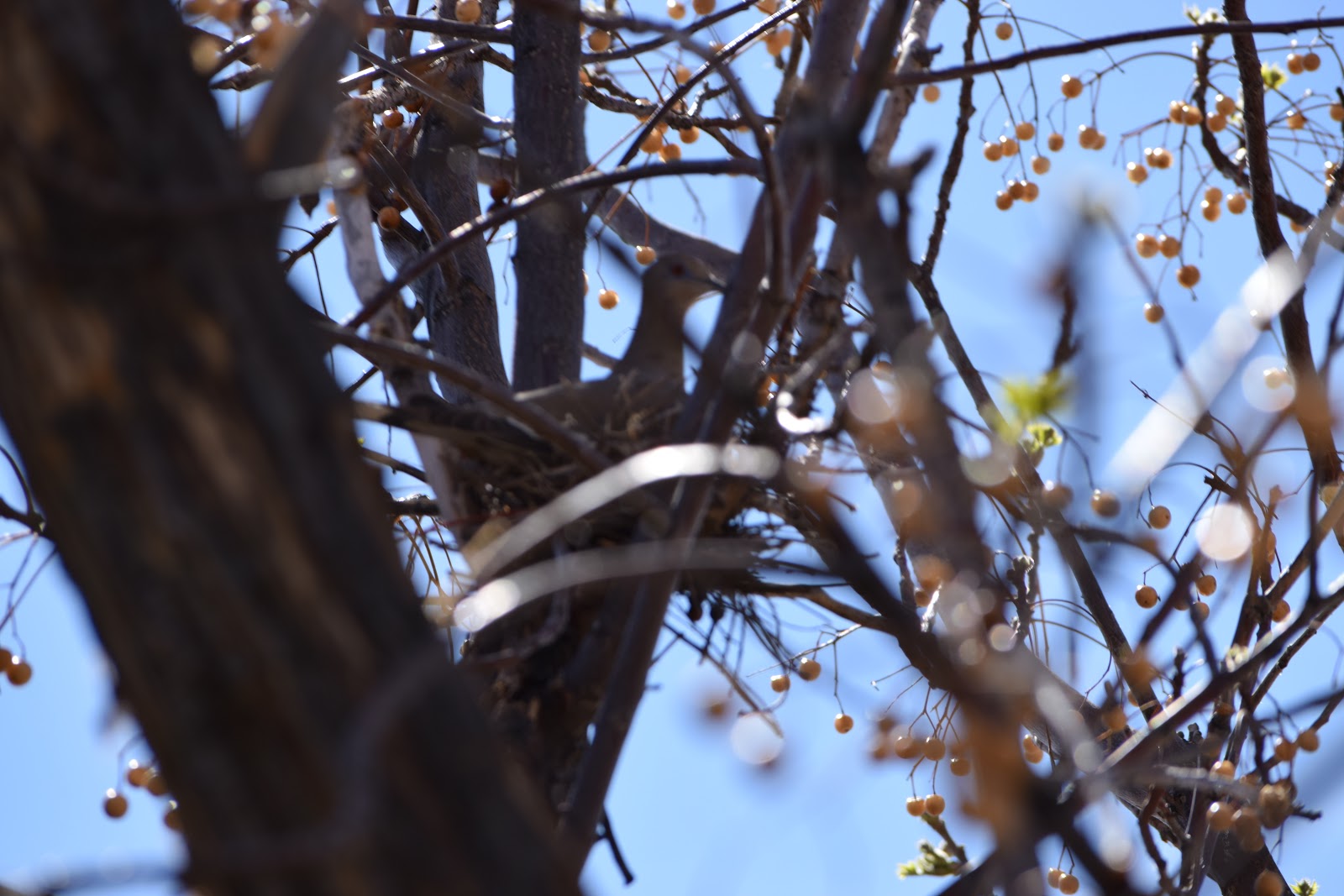
Not nearly as shy is this pair of doves that are nesting here.  This is the female on her nest.


Here is a close-up view of her.  This is probably the same pair that fledged their young from this nest last summer when we had first moved in.  I understand they mate for life.


The male dove stays near-by and keeps watch on his lady.  A male dove wakes me up each morning by perching on the chimney of our fireplace and cooing as loud as he can.  Wake up time is 7:15 am.  Since it is a mating call, I do not know if it is the same dove.


Sparrows visit our neighborhood also.  They are welcome.


These two pictures are of what I believe is a House Finch.  Among other things, photographing this shy little bird tells me I need to get a telephoto-lens.


This most likely the female the male finch was courting.  We had moved our "home" back to Percha Dam State Park.  This pair would sing in the tree by our trailer.  As soon as I grabbed my camera, they flew to the far side of the tree.  These photos were lucky shots.


In the early spring, the early bird gets the worm.  Yes, it is a Robin.
Sorry she was in the shadows.


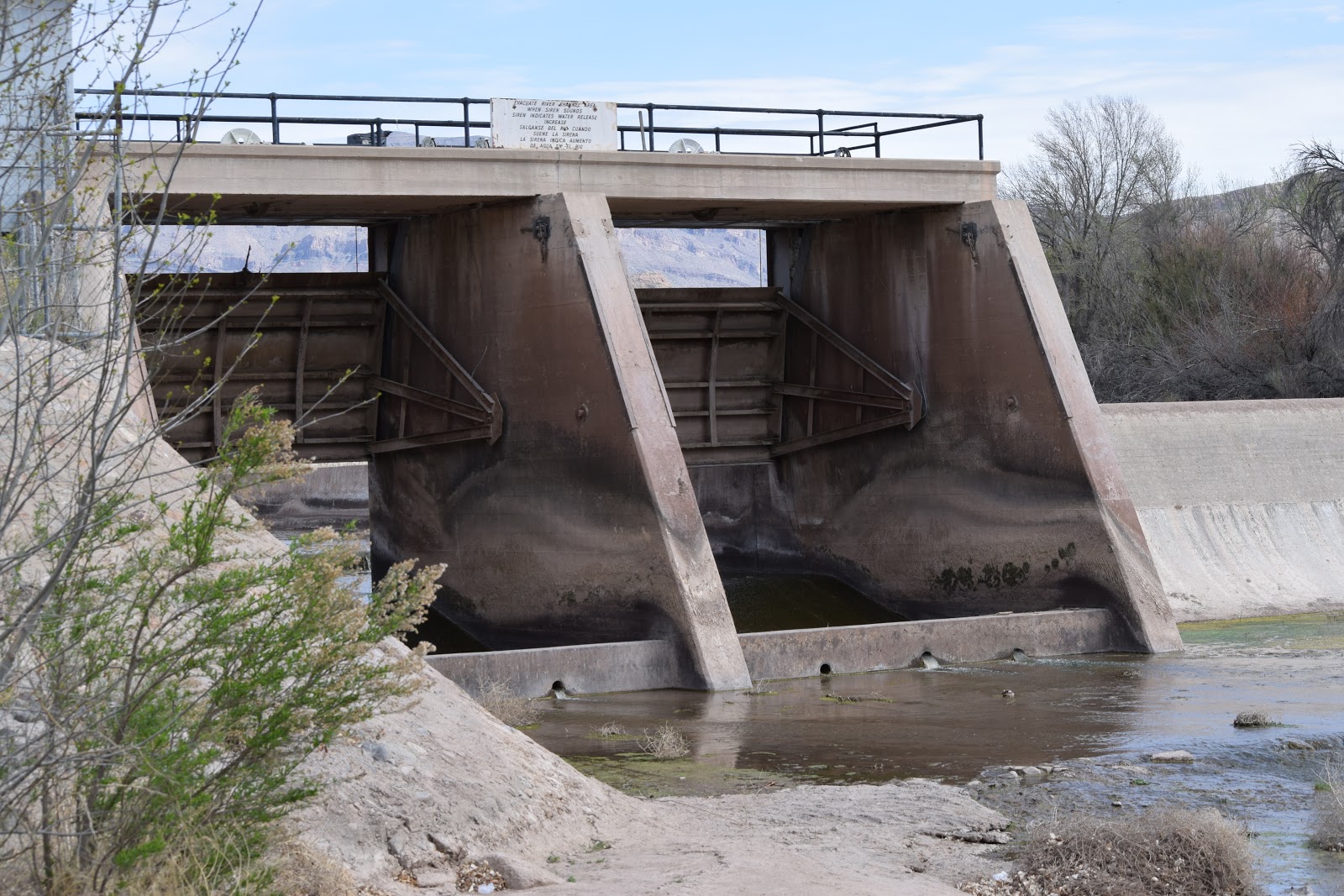
The spillway at Percha barely has a trickle of water passing through.  Most of the water is held upstream behind the Caballo and Elephant Butte Dams until irrigating begins.


Here is what the dam looks like without the water flowing over it.


Here is the same view taken last summer during our first stay at Percha Dam State Park.

Tuesday, March 7, 2017

La Llorona Park

One of our favorite forms of exercise here in New Mexico is bicycle riding. The best bicycling in Las Cruces is along the Rio Grande.  For us the ride begins at La Llorona Park next to the bridge on Picacho.

This is the bridge that crosses the Rio Grande from the east side, or Las Cruces side.


The sign that greets you as you turn into La Llorona park is more proof that this is the Rio Grande.


This is the parking area where we load and unload our bikes.  You can see ours in our pickup truck.  Notice the lack of Rio (or water) in the background beyond the truck.  We had a visit with one of Margaret's sister who wanted to see the Rio Grande.  She was amazed at the lack of water.  The water is held behind the Elephant Butte and Caballo Dams for irrigation purposes.  When the farmers begin irrigating, there will be water in the Rio.


Here is the view of the bridge from the parking area.  There is a path for foot traffic and bicycles to go "upstream" from the parking area.


Looking south you see the bike and walking path.  It is marked off with marker posts every quarter of a mile.  We are frequently greeted by friendly fellow bicyclers and walkers.


There is water in the Rio Grande bed.  This water comes from the sewage treatment plant in the town of Mesilla located to the east of this location. Notice the Organ Mountains in the distance.


The bridge on the bike path crosses over the drainage ditch.  You can see how the water enters the dry river bed.  From this point on it could be called Rio Pequeno (Small River), or Riachuelo (Creek or Stream).


The stream and bike path cross under Interstate 10 which goes all the way across the country from San Diego, California to Florida.


Several species of ducks can be found along the river basin.  These are mostly mallards.  We have seen crows, hawks, Pyrrhuloxia (a cardinal species), and of course roadrunners.


As we approached from the north another couple were walking towards us from the south.  They had two honey colored standard poodles on leashes. This roadrunner was caught in between in an area where there was little ground cover.  He took refuge in the tree.  He did not fly up into the tree, but jumped up into the tree.

I wondered if they can even fly so I checked the internet.  Here is what wikipedia reports: 
Roadrunners and other members of the cuckoo family have zygodactyl feet. The roadrunner can run at speeds of up to 20 miles per hour (32 km/h) and generally prefer sprinting to flying, though it will fly to escape predators. During flight, the short, rounded wings reveal a white crescent in the primary feathers.


I captured several photos of this roadrunner as he ran across the path.  I selected this one for the blog because he stopped and posed for me.


Here is a view of the end of the trail.  It is 3.3 miles from La Llorona Park.


A long ride deserves a rest break along the way.  We take pillows to soften the seats on the park benches.


Riding alone one day it took me 38 minutes to make the round trip of 6.6 miles.


Looking towards the east you see the beautiful jagged peaks of the Organ Mountains.


Back at the start, looking towards the west, one can see this mountain.  I do not know if it has a name, but it reminds me of R Mountain near Rexburg, Idaho.  I think I found out the name of this mountain.  It is Pichacho Peak.  At least there is a Pichacho Peak Brewery near here.